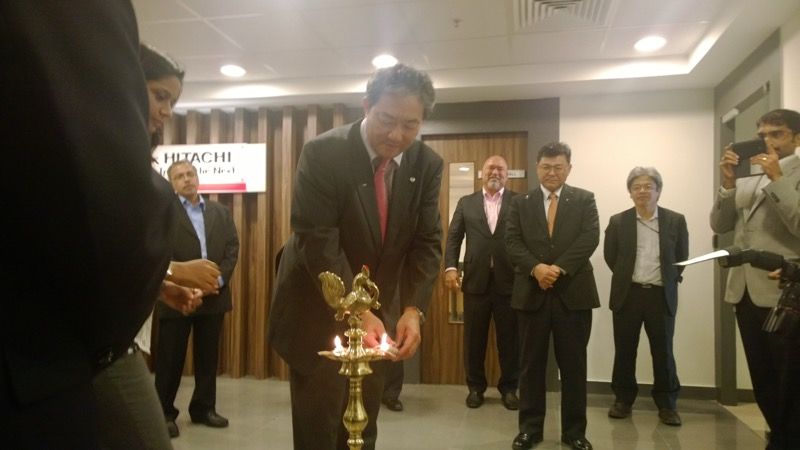
In December 2013 I stood in a new office in Hyderabad and helped light a ceremonial lamp to open it. The team gathered under marigold garlands for a photo. It's one of my favorite memories from my career, and not because of the building. It's because of what that moment represented: a group of people who were about to become a real team, building real products, for customers on the other side of the world.
Building product engineering teams is the work I love most. I've had the chance to do it across the US, India, EMEA, Japan and Ukraine, including global development centers in India, Europe and Southeast Asia, with work in Thailand and the Philippines. I've learned a lot more from those teams than I ever taught them. Here's some of what I learned.
Start with one window to the customer
When I established Hitachi's Global Center of Excellence in 2013, the idea was simple: teams in North America, Southeast Asia, India, Japan and EMEA, giving Hitachi a single window to accelerate global growth. It supported Hitachi, Ltd., a $100B business with 300,000 employees.
Global teams in North America, Southeast Asia, India, Japan and EMEA meeting the customer through one window.
- ·North AmericaTeam region
- ·Southeast AsiaTeam region
- ·IndiaTeam region
- ·JapanTeam region
- ·EMEATeam region
- →One customer windowOne team, one standard, one point of accountability
The lesson I took from that: customers don't want to manage your org chart. However distributed your team is, the customer should experience one team, one standard and one point of accountability. If they feel the seams, you've built it wrong.
Build the lead pod first
Whenever I start something new, I don't begin by hiring fifty people. I begin with a lead pod: a small, cross-functional group of architecture, engineering, design and someone who understands the business and the sale. That pod wins the first work, architects it, oversees it and handles escalations. Once it works, you have a repeatable formula. Then you add functional pods behind it and scale.
This is the "0 to 1, then 1 to N" pattern I've used again and again. At Iteration2, that focus looked like specific industries, real referrals, and a team that cared how things turned out for the customer. You can't fake that with headcount.
What GlobalLogic taught me about global engineering
GlobalLogic was already a leader in global product engineering when I joined. Working there taught me more about building and running distributed engineering organizations than I can fit into one article. The depth of talent across centers, the discipline of delivering for demanding product companies, and the way local leaders owned quality while staying connected to a global standard — those lessons still shape how I think about teams.
I don't claim I invented that model. I was fortunate to learn it inside a company that had already built it well, and then to put pieces of that learning to work in the roles that came after.
Helping stand up global engineering at RSM
At RSM, the global engineering effort was very young when I got involved. I drew on what I'd learned at Hitachi Solutions and GlobalLogic to help build it, starting with a core group of engineers across India. The work was collaborative: local leaders, colleagues who knew the firm, and a shared commitment to one engineering standard the customer could trust. I'm proud of what that early group began. I'm also clear that building something like this is never a one-person story.
Offshore isn't a cost line. It's a capability.
Too many companies think of global development centers as a way to make engineering cheaper. That mindset gets you exactly what you pay for. When we expanded Hitachi's business with an offshore team in India and a presence in the UK, and later helped set up Hitachi Solutions India, APAC, Europe and America, the goal was capability and reach, not just rate.
In product engineering, what matters most isn't how much you're spending. It's what you can build that grows the top line. If every conversation is about price, you end up competing with every low-cost provider out there. Build a team that customers want because of what it creates.
Respect the culture you're joining
Every location has its own way of working, celebrating and communicating. Lighting that lamp in Hyderabad wasn't a photo op. It was the team inviting us into how they mark a new beginning. Building teams across cultures and time zones means listening first, learning the rhythms of the place, and trusting local leaders. The best ideas I've seen often came from engineers far from headquarters who saw the problem more clearly than we did.
Take care of people when it's hard
In 2022, at GlobalLogic, our Ukraine-based colleagues had to relocate. My job was simple to say and hard to do: keep people safe and keep our promises to clients. We did both. A crisis tests character more than strategy. If your team knows you'll stand with them when things get hard, they'll stand with you and with your customers.
Engineering discipline travels
What holds a distributed team together is shared engineering discipline. I think about product engineering as a lifecycle, ideation, architecture, engineering, DevOps and run operations, with a feedback loop from customers and the market running back into the next idea. And I hold every team to the same pillars: quality, performance, feasibility, scalability, security and maintainability. Those standards are a common language. An engineer in Pune and an engineer in Irvine should be able to look at the same architecture and agree on what "done" means.
Why this matters more with AI
AI-led engineering and transformation doesn't make teams less important. It makes the shape of the team more important. AI lets a small, strong pod do what used to take a much bigger group, but only if the pod has the right mix: architecture, engineering, design and business sense, plus the judgment to check what the tools produce. The global model I learned building development centers — at Hitachi Solutions, at GlobalLogic, and in the early work at RSM — is exactly how I think about AI-era engineering teams: distributed, disciplined and close to the customer.
What I'd tell a leader starting today
- Start with one lead pod and a repeatable win formula.
- Give customers one window, however global you are.
- Treat global centers as capability, not cost.
- Respect local culture and trust local leaders.
- Share one engineering standard everywhere.
- Take care of your people first, especially in a crisis.
The tools keep changing, now faster with AI. What makes them work hasn't: good people, honest partnerships, and the patience to build something that lasts.
I write about building teams and businesses through every technology shift. More at simon-chan.com.